Comparative Macro-microscopic Atlas of Two Aroids Used in Siddha Medicine
DOI:
https://doi.org/10.5530/jams.2017.2.32Keywords:
Karakarunai, Sembu, Raphide bundlesAbstract
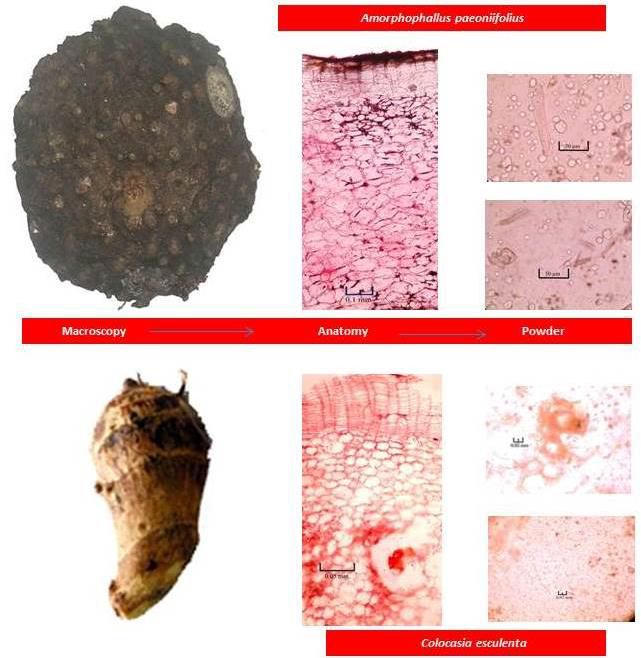
Introduction: Amorphophallus paeoniifolius and Colocasia esculenta, two aroids used as a source of food possess various medicinal properties too. The present study is aimed at the macro microscopic comparison of these two species. Methods: The fresh rhizomes of the A. paeoniifolius and C. esculenta were collected from Mettur and market respectively. Detailed macroscopy followed by anatomy and powder characters were studied in accordance to standard pharmacopoeial procedures. Results: The two rhizomes differed morphologically; A. paeoniifolius is larger and blackish brown externally while C. esculenta is lighter in colour with concentric rings of leaf scars. The rhizome transverse section also showed difference in number of cork layers (less in A. paeoniifolius). The inner cork cells contained rosette crystals in A. paeoniifolius (absent in C. esculenta). Raphide bundles of acicular crystals are present in A. paeoniifolius (prismatic crystals in C. esculenta). Starch grains both simple and compound were present in both species but the grains in C. esculenta were comparatively smaller when compared to A. paeoniifolius. Mucilage cells are seen in both rhizomes while latex tube was visible only in A. paeoniifolius. These differences were reflected in the powder microscopy of the two species. Conclusion: The outcomes of the paper provides a crisp and concise information about the detailed macro -microscopy of the two aroid medicinal plant materials.